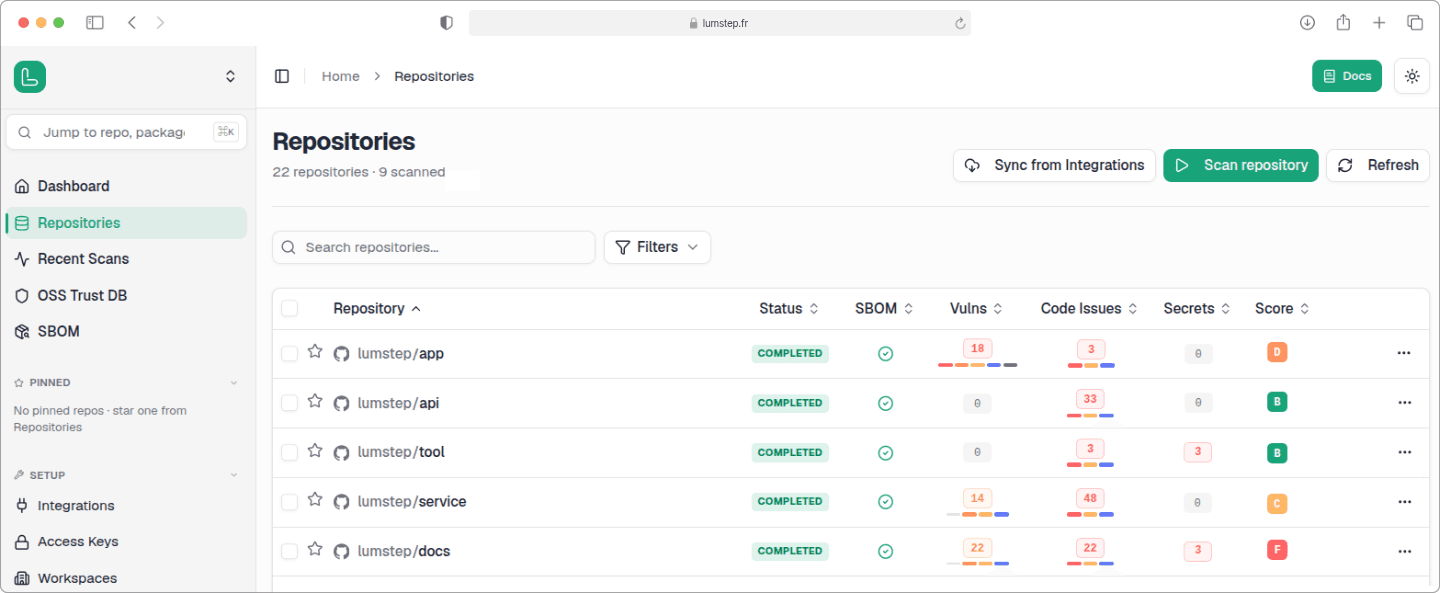
The security platform from findings to fixes
Lumstep scans your repos for vulnerable dependencies, leaked secrets, and unsafe code. Then handles the prioritization, the fixes, and the pull requests.
One platform built by engineers, for engineering teams. No security expertise, no extra dashboard to check, no sweat.
Right now, the average team is carrying months of unpatched risk and doesn't know it
Vulnerabilities don't wait for your next sprint. Every day a known vulnerability sits unpatched in your stack is a day an attacker is reading the same disclosure you haven't gotten to yet. Attack methods multiply fast, especially in the AI era. You don't have to be a target. You just have to be exposed. There's just patched and not patched.
OWASP Top 10 2025 · A03: Software Supply Chain FailuresSources: IBM Cost of Data Breach Report 2025 · OSSRA 2026 · FIRST Vulnerability Report 2026 · CrowdStrike Global Threat Report 2026
Security that actually ships fixes
Most security tooling is very good at one thing: handing you a longer list of problems. Different logins, different dashboards, different definitions of "critical" and still nobody merging anything. Lumstep runs the whole stack in the background and hands you the fix, not the homework. Here's exactly what's happening under the hood.
Lumstep's AI writes the PR. You just click merge.
When a dependency has a known vulnerability, Lumstep finds an upgrade path - weighing the blast radius of version changes and following semver rules. And opens a pull request with the diff and the reasoning. No script to configure, no tool to install.
Know exactly what your code is built on.
A complete inventory of every package, version, and license in your codebase, graded for quality is generated on every scan. Exportable for auditors and compliance teams.
Every dependency checked against known vulnerability databases.
Every package in your dependency tree is scanned for known vulnerabilities. Critical findings come with real-world context, whether the vulnerability is being actively exploited and how likely it is to be targeted. So the report tells you what needs fixing now, not just what's technically flagged.
Cuts the noise. Surfaces what to fix this sprint.
Most scanners dump hundreds of alerts on you and call it a day. Every finding here is ranked by whether it's actively exploitable in the wild and whether you depend on the package directly. Then surfaces only the handful that are actually worth fixing.
Catches security flaws in the code your team and AI agent write.
Not all risk lives in your dependencies. Your own code gets scanned too for potential security issues and highlights where they occur. For each finding, it points to the relevant code, explains the issue, recommends a fix, and creates a Linear ticket so it doesn't get lost.
Every library you ship gets a trust score.
Packages your code depends on get evaluated: maintainer activity, contributors, dependency hygiene, CI setup, and risk signals like single-maintainer projects, license type or binary in repo. High-risk packages are flagged in the report.
Block pull requests that drop your security score.
Your repos have a security score. One line in your CI pipeline blocks any pull request that drops the score below your threshold. Risky changes are caught in review, not after they merge.
Scans your code and full git history for leaked credentials.
Scans your working tree and full git history for leaked credentials - API keys, tokens, and passwords - and reports the exact file and line. Where possible, each credential is tested to determine whether it's still active or has already been rotated.
The code everyone's afraid to touch.
Security isn't the only thing that rots. Lumstep tracks the health of your codebase: dead code nobody calls anymore, functions that have grown too complex to touch safely.
Connect to your existing stack in one click.
Sign in with GitHub or GitLab, your team joins the same way. Dependency fixes land as pull requests. Code findings can become Linear tickets automatically for critical issues, or from one button in the dashboard. No agents to deploy, nothing new to maintain.
Connect once. A scan runs on every push
Push a commit, open a pull request, or trigger one from the dashboard Lumstep runs a full scan either way. Secrets, vulnerabilities, SBOM, code quality. All in one report.
Connect a repo
Sign in with GitHub or GitLab. No agents to install, no config to write, no platform-team ticket.
Run a scan
Push a commit, open a pull request, or trigger from the dashboard.
Your report is ready
For fixable findings, Lumstep opens pull requests with the change and an explanation.
Frequently Asked Questions
Learn everything you need to know about Lumstep. Looking for more? Check the docs
Does Lumstep store my source code?
No. Source archives are processed in-memory inside of temporary container, unique to you, during scanning and never persisted. Lumstep stores only scan results and metadata. The platform is hosted on EU infrastructure.
How does Lumstep fix vulnerabilities automatically?
When Lumstep finds a vulnerable dependency with a safe upgrade path, it calculates the version bump and opens a pull request automatically. SAST findings become Linear tickets.
Which platforms does it connect to?
GitHub and GitLab today, via a one-click OAuth connection. No agents to install, no CI config to write, and no platform-team ticket to open. It also supports Linear integration to track bigger changes.
Do I have to change my CI pipeline?
No. Lumstep runs on every push and pull request automatically once a repo is connected - or you can trigger a scan from the dashboard. Nothing to add to your existing workflow.
What does Lumstep actually scan for?
Every scan covers multiple things in one pass: your SBOM generated, vulnerable dependencies (direct and transitive), code-quality issues, leaked secrets and code-health metrics. One report, one dashboard - not separate tools.
How does the auto-fix pull request work?
For fixable findings, Lumstep opens a PR with the exact change and the advisory it. You review and merge, the fix is never applied without you.